Saturday, June 30, 2018

PAST INDEFINITE TENSE


Past Indefinite Tense:- The Tense which is used to denote an action in past time is called past indefinite tense.

वह Tense जिसका प्रयोग बीते हुए समय में किसी कार्य को सुचित करने के लिए किया जाता है उसे past indefinite tense कहते है |

Identification:-वाक्य के अन्त में आ, इ, ए, था, थे, थी, या, ये, यी, चुका, चुके, चुकी तथा ता था, ते थे, ती थी आदि पाया जाता है |

Stru:- S+V2+O+R.M.    

Rule:-1. We use ‘V2’ only in affirmative sentence with all subject  I, We, You, They, He, She, It, single name and two or more than two name.

I, We, You, They, He, She, It,
single name and                                       -     V2
two or more than two name.
         
2. In Negative Sentence, We use ‘did’ after the subject and then ‘not’.
                                        Did not       =        didn’t


3.When we use ‘did’ in any sentence then V2 change in V1. That mens we use ‘V1’ with all subject in all sentences except affirmative.

          Affirmative              -     V2

          Negative
          Interrogative
          Interrogative Negative       -  V1
          W-H Question

4.In Interrogative sentence, we use ‘Did’ before the subject and then v1.
5.In Interrogative Negative sentence, we use ‘Did’ before the subject and ‘not’ after the subject and then v1.


E.g. of Past Indefinite:-
AFFIRMATIVE

Stru:- S+V2+O+R.M.
1.मै मुम्बई गया था|
 I went Mumbai.
2.माधुरी किताब पढ़ती थी|
 Madhuri read a book.
3.वह उस पर हँसा था|
 He laughed at her.
4.मैंने तुम्हें पचास रुपये उधार दिये थे|
 I lent you fifty rupees.
5.वह एक पत्र लिखती थी|
 She wrote a letter.

NEGATIVE

Stru:- S+did+not+V1+O+R.M.
1.मैं मुम्बई नहीं गया था|
 I did not/didn’t go to Mumbai.
2.माधुरी किताब नहीं पढ़ती थी|
 Madhuri did not/didn’t  read a book.
3.वह उस पर नहीं हँसा था|
 He did not/didn’t laugh at her.
4.मैंने तुम्हें पचास रुपये उधार नहीं दिये थे|
 I did not/didn’t lend you fifty rupees.
5.वह एक पत्र नहीं लिखती थी|
 She did not/didn’t write a letter.


INTERROGATIVE

Stru:- Did+S+V1+O+R.M.
1.क्या मैं मुम्बई गया था?
 Did I go to Mumbai?
2.क्या माधुरी किताब पढ़ती थी?
 Did Madhuri read a book?
3.क्या वह उस पर हँसा था?
 Did He laugh at her?
4.क्या मैंने तुम्हें पचास रूपये उधार दिये थे?
 Did I lend you fifty rupees?
5.क्या वह एक पत्र लिखती थी?
 Did She write a letter?

INTERROGATIVE NEGATIVE

Stru:- Did+S+not+V1+O+R.M.
1.क्या मैं मुम्बई नहीं गया था?
  Did I not go to Mumbai?
2.क्या माधुरी किताब नहीं पढ़ती थी?
 Did Madhuri not read a book?
3.क्या वह उस पर नहीं हँसा था?
 Did He not laugh at her?
4.क्या मैंने तुम्हें पचास रुपये उधार नहीं दिये थे?
 Did I not lend you fifty rupees?
5.क्या वह एक पत्र नहीं लिखती थी?
 Did She not write a letter?

W-H QUESTIONS

Stru:- Q.W.+did+S+not(if require)+ V1+O+R.M.
1.मैं मुम्बई कब गया था?
 When did I go to Mumbai?
2.माधुरी किताब कहाँ पढ़ती थी?
 Where did Madhuri read a book?
3.वह उस पर क्यों हँसा था?
 Why did He laugh at her?
4.मैंने तुम्हें पचास रुपये कब उधार दिये थे?
 When did I lend you fifty rupees?
5.वह एक पत्र क्यों लिखती थी?
 Why did She write a letter?


Friday, June 29, 2018

PRESENT PERFECT CONTINUOUS TENSE

                             
Present Perfect Continuous Tense:-The Tense which shows that an action has been continuing in present time for a long period is called present perfect continuous tense.

वह Tense जो यह दर्शाता है कि कोई काम वर्तमान समय में एक लम्बे समय तक जारी हो, उसे present perfect continuous tense कहते है |
Identification:-वाक्य के अन्त में ता रहा है, ते रहे है, ती रही है तथा रहा है, रहे है, रही है आदि पाया जाता है |

Stru:-S+have been/has been+V4+O+R.M.

Rule:-1.We use ‘have been’ with I,We,They,You and two or more than two name and ‘has been’ with He,She,It and any single name and then use V4.
                   
 I, We, They, You
and                                                -have been
two or more than two name        

He,She,It
And                                        -has been
Any single name        

2.In Negative Sentence, We use ‘not’ in the middle of have been/has been.
3.In Interrogative Sentence, We use only Have/Has before the subject.
4.We use ‘since’ for point of time and ‘for’ for period of time.

                 Since = point of time
         E.g:- since morning
                 Since Monday
                 Since January
                 Since 1997
                 Since 4 o’ clock

                 For = period of time
         E.g:- for two days
                 For three months
                 For five years
                 For seven hours
        
5.In Interrogative Negative Sentence,We use have/has before the subject and ‘not’ after the subject.

e.g of present perfect continuous tense:-

                                  AFFIRMATIVE

Stru:-S+have been/has been+V4+O+for/since+time
1.हमलोग 15 दिनों से पढ़ रहे है |
 We have been reading for 15days.
2.मै सुबह से खेल रहा हूँ |
 I have been playing since morning.
3.राम 2001 से यह काम कर रहा है |
 Ram has been doing this work since 2001.
4.वह 5 बजे से लिख रहा है |
 He has been writing since 5 o’ clock.
5.वह 5 घंटो से लिख रहा है |
 He has been writing for 5 hours.

NEGATIVE

Stru:S+have/has+not+been+V4+O+for/since+time
E.g:-1.हमलोग 15 दिनों से नहीं पढ़ रहे है |
 We have not been reading for 15days?
2.मै सुबह से नहीं लिख रहा हूँ |
I have not been playing since morning?
3.राम 2001 से यह काम नहीं कर रहा है |
 Ram has not been doing this work since 2001?
4.वह 5 बजे से नहीं लिख रहा है |
He has not been writing since 5 o’ clock?
5.वह 5 घंटो से नहीं लिख रहा है |
He has not been writing for 5 hours?

                                  INTERROGATIVE

Stru:- Have/Has+S+been+V4+O+for/since+time
E.g:-1.क्या हमलोग 15 दिनों से पढ़ रहे है ?
have We not been reading for 15days?
2.क्या मै सुबह से खेल रहा हूँ ?
 have I not been playing since morning?
3.क्या राम 2001 से यह काम कर रहा है ?
has Ram not been doing this work since 2001?
4.क्या वह 5 बजे से लिख रहा है ?
has He not been writing since 5 o’ clock?
5.क्या वह 5 घंटो से लिख रहा है ?
has He not been writing for 5 hours?

INTERROGATIVE NEGATIVE

Stru:- Have/Has+S+not+been+V4+O+for/since+time
E.g:-1.क्या हमलोग 15 दिनों से नहीं पढ़ रहे है ?
 have We not been reading for 15 days?
2.क्या मै सुबह से नहीं लिख रहा हूँ ?
 have I not been playing since morning?
3.क्या राम 2001 से यह काम नहीं कर रहा है ?
has Ram not been doing this work since 2001?
4.क्या वह 5 बजे से नहीं लिख रहा है ?
has He not been writing since 5 o’ clock?
5.क्या वह 5 घंटो से नहीं लिख रहा है ?
has He not been writing for 5 hours?

                W-H QUESTIONS

Stru:- Q.W+Have/Has+S+not(if require)+been+V4+O+for/since+time
E.g:-1.हमलोग 15 दिनों से क्यों नहीं पढ़ रहे है ?
 Why have We not been reading for 15days?
2.मै सुबह से कब खेल रहा हूँ ?
 When  have I been playing since morning?
3.राम 2001 से यह काम कैसे कर रहा है ?
How has Ram been doing this work since 2001?
4.वह 5 बजे से क्या लिख रहा है ?
What has He been writing since 5 o’ clock?
5.वह 5 घंटो से क्यों नहीं लिख रहा है ?
Why has He not been writing for 5 hours?


Wednesday, June 27, 2018

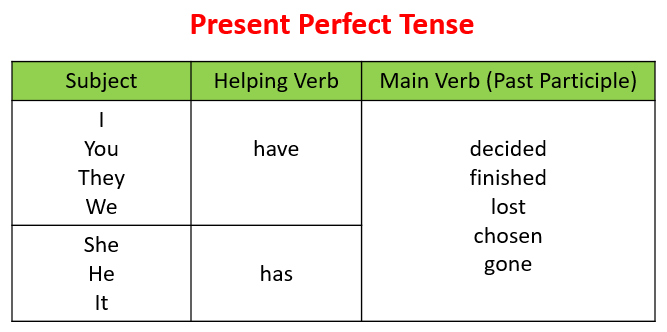
PRESENT PERFECT TENSE

   
Present Perfect Tense:-The Tense which shows a completed event in present time is called present perfect tense.

वह Tense जो वर्तमान समय में किसी पूर्ण कार्य को दर्शाता है, उसे present perfect tense कहते है |

Identification:-वाक्य के अन्त में या है, ये है, यी है तथा चुका है, चुके है, चुकी है आदि पाया जाता है |

 Stru:- S+have/has+V3+O+R.M.

Rule:-1. We use ‘have’ with I,They,We,You and two or more than two name and ‘has’ with He,She,It and any single name and then use V3.

I
We
They
You                                                    -  have           
We and
Two or more than two name                                               

He
She                                              
It                                     -      has
And
Any single name  
Related image   
2.In Negative sentence, We use ‘not’ after the have/has.
3.In Interrogative sentence, We use have/has before the subject.
4.In Interrogative Negative sentence, We use ‘not’ after the subject instead of this We also use short form of have not(haven’t)/has not(hasn’t).
                       Have not      =    haven’t
                       Has not         =    hasn’t

5. What is V3?
Ø V3 is also called third form of verb.
V1                                         V2                                     V3
Go                                        went                                gone
Come                                   came                               come
Play                                      played                             played
Write                                   wrote                              written
Ask                                       asked                               asked
Cut                                       cut                                   cut
Hit                                        hit                                    hit etc.

E.g. of Present Perfect Tense:-

AFFIRMATIVE

Stru:-S+have/has+V3+O+R.M.
1.मैंने उसे सूचित कर दिया है |
I have informed him.
2.चाची चाय पी चुकी है |
 Aunti has taken tea.
3. मेरी माँ मंदिर गयी है |
 My Mother has gone to temple.
4.वे लोग लिख चुके है |
 They have written.
5.वे लोग दो बार मुझसे पुछे है |
 They have asked to me two times.

NEGATIVE

Stru:- S+have/has+not+V3+O+R.M.
1.मैंने उसे सुचित नहीं किया है |
I have not/haven’t informed him.
2.चाची चाय नहीं पी चुकी है |
Aunti has not/hasn’t taken tea.
3.मेरी माँ मंदिर नहीं गयी है |
My Mother has not/hasn’t gone to temple.
4.वे लोग नहीं लिख चुके है |
They have not/haven’t written.
5.वे लोग दो बार मुझसे नहीं पुछे है |
They have not/haven’t asked to me two times.


INTERROGATIVE

Stru:-Have/Has+S+V3+O+R.M.
1.क्या मैंने उसे सुचित किया है ?
Have I informed him?
2.क्या चाची चाय पी चुकी है ?
Has Tanni Aunti taken tea?
3.क्या मेरी माँ मंदिर गयी है ?
Has My Mother gone to temple?
4.क्या वे लोग लिख चुके है ?
Have They written?
5.क्या वे लोग दो बार मुझसे पुछे है ?
Have They asked to me two times?

INTERROGATIVE NEGATIVE

Stru:-Have/Has+S+not+V3+O+R.M.
1.क्या मैंने उसे सुचित नहीं किया है ?
Have I not informed him?/ Haven’t  I informed him?
2.क्या चाची चाय नहीं पी चुकी है ?
Has Tanni Aunti not taken tea?/Hasn’t  Tanni Aunti taken tea?
3.क्या मेरी माँ मंदिर नहीं गयी है ?
Has My Mother not gone to temple?/ Hasn’t My Mother gone to temple?
4.क्या वे लोग लिख नहीं चुके है ?
Have They not written?/ Haven’t They written?
5.क्या वे लोग दो बार मुझसे नहीं पुछे है ?
Have They not asked to me two times?/Haven’t They asked me two times?

W-H QUESTIONS

Stru:- W-H Que+have/has+not(if require)V3+O+R.M.
1.मैंने उसे क्यों सुचित नहीं किया है ?
Why have I informed him?
2.चाची कब चाय पी चुकी है ?
When has Aunti taken tea?
3.मेरी माँ कौन मंदिर गयी है ?
Who has My Mother gone to temple?
4.वे लोग कब लिख चुके है ?
When have They written?
5.वे लोग कहाँ दो बार मुझसे पुछे है ?
Where have They asked to me two times?

basic spoken english

  अंग्रेजी   बोलचाल   सीखने   के   लिए   अंग्रेजी   में   अभिवादन   का   होना   आवश्यक   है   |  हम   दिन   के   समय   या   किसी   अन्य   सम...